
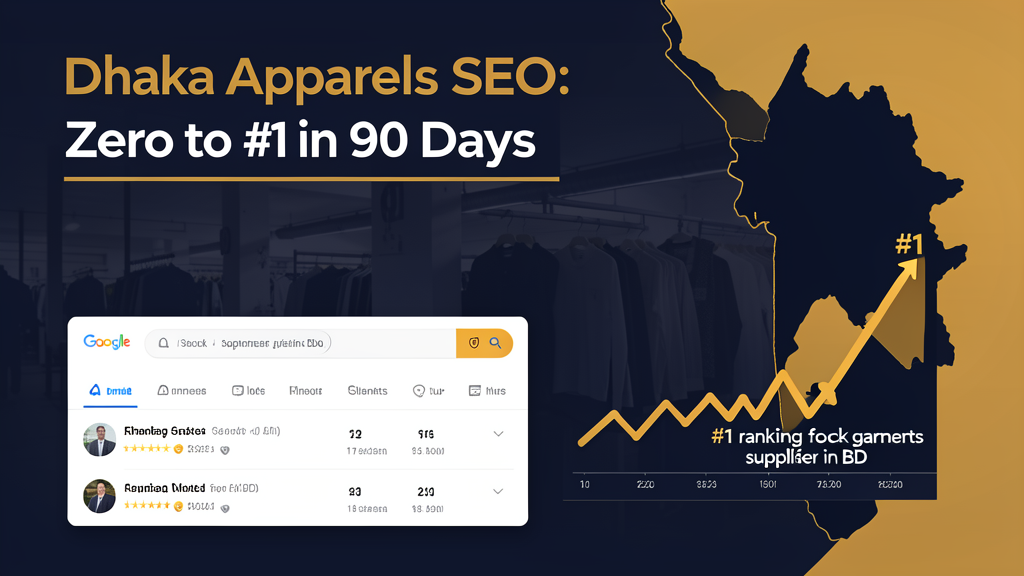
In September 2025, Dhaka Apparels didn’t just lack rankings — it didn’t exist online. No domain history. No backlinks. No Google Business Profile. No indexed pages. Nothing.
Within 90 days, they achieved #1 ranking for “best stock garments supplier in bd,” generated 14,700 impressions, and appeared in Google’s AI-generated search summaries — all from a completely fresh domain with zero prior authority. For a B2B garments sourcing company entering a competitive market, this turnaround demonstrates that a systematic SEO approach can overcome even the most daunting starting point.
I’m Kanok Miah, SEO Project Manager at Khan IT. This is how I planned and executed the entire SEO strategy for Dhaka Apparels — a garments sourcing company — taking them from complete digital obscurity to the top of Google in just 3 months.
About the Client: Dhaka Apparels
Dhaka Apparels is a B2B garments sourcing and stock-lot supply company based in Bangladesh. Their target customers include retail chain buyers, overseas importers, stock-lot resellers, and garment sourcing agents — all of whom search on Google for reliable suppliers. The Bangladeshi ready-made garments (RMG) sector is the second-largest apparel exporter in the world, contributing over $40 billion annually to the national economy. Yet the majority of mid-size garment suppliers in Bangladesh have minimal or zero digital presence, creating a massive opportunity for those who invest in SEO early.
When they approached me, they had:
- Zero domain authority — a completely new website
- Zero indexed pages — Google hadn’t crawled anything
- Zero backlinks — no citations, no directories, no mentions
- Zero Google Business Profile — no local search presence
- Competitors with 5+ years of SEO history, hundreds of pages, and established backlink profiles
In short: a blank slate. But as I’ve learned from 210+ SEO projects, starting from zero is not a disadvantage — it’s a clean slate with no technical debt to undo.
Keyword Research: Finding the Right Opportunities
Before writing a single line of content, I conducted a comprehensive keyword analysis to identify the highest-value opportunities for a new domain. The criteria were: search volume with clear commercial intent, low-to-medium keyword difficulty, and strong relevance to Dhaka Apparels’ core services.
The top contenders included terms like “best stock garments supplier in bd,” “garments sourcing Dhaka,” and “Bangladesh apparel manufacturer.” These queries consistently appear in B2B sourcing workflows — a procurement manager typically starts with a broad search, then narrows by location and product type. By targeting these mid-funnel keywords with dedicated pages, we maximized the likelihood of connecting with buyers already in decision mode.
Keyword difficulty (KD) analysis using SEO tools confirmed that most of our target terms had KD under 18 — achievable for a new domain with the right content strategy. This data-driven selection process ensured we invested every content dollar where it would produce the fastest ROI.
The Strategy: 5-Phase SEO Execution
I developed a structured 5-phase plan that prioritized foundation first, content second, technical optimization third, local presence fourth, and authority last. This is the same methodology I use in my technical SEO audit and consulting work.
Phase 1: The Right Foundation (Month 1)
The website was built as a lead-generation asset, not a brochure. Every design decision was made with SEO and conversion in mind:
- Server response time: Under 200ms — critical for both user experience and Google’s Core Web Vitals
- Page load speed: Under 2 seconds on mobile — mandatory for Bangladesh’s mobile-first audience
- Mobile-first design: Thumb-friendly navigation, click-to-call buttons, short inquiry forms
- SEO-optimized URL structure: Clean, keyword-rich URLs like
/stock-lot-tshirts-bd/ - Logical internal linking: Clear product categories with contextual cross-links
- Inventory proof: Immediate social proof of stock scale, export capability, and fast communication access within the first scroll
This foundation phase is critical. Without it, no amount of content or backlinks will produce sustainable rankings. I always start with a full on-page SEO and technical foundation before anything else.
Phase 2: Content That Converts (Month 1–2)
Most SEO campaigns write content for algorithms. I wrote for sourcing managers — real people with real purchasing decisions to make.
Content approach:
- Addressed real B2B buyer objections: MOQ (minimum order quantity), export documentation, quality grading, container capacity
- Used short paragraphs, bullet breakdowns, and direct answers — not lengthy fluff
- Created dedicated pages for: core service categories, stock-lot product types, trust-driven About page, optimized Contact page with inquiry forms
- Each page targeted a specific long-tail keyword with clear commercial intent
I focused on depth over volume: fewer pages with greater depth and higher conversion intent, rather than hundreds of thin pages.
Phase 3: Technical SEO & AI Readiness (Month 1–2)
Technical SEO was not an afterthought — it was built into every page from day one:
- Optimized title tags and meta descriptions — unique for every page, with primary keywords early
- Proper H1–H3 heading hierarchy — clean, logical, and keyword-aligned
- XML sitemaps submitted to Google Search Console
- WebP image format for faster loading
- HTTPS with proper redirects
- Organization + Product structured data (Schema markup)
- AI Search Optimization: Built concise answer blocks under headings, structured FAQs, and improved semantic clarity specifically to win AI-generated search summaries — which we achieved
The AI search optimization part was particularly important in 2025. Google’s Search Generative Experience (SGE) and AI overviews pull answers from well-structured content. By organizing our pages with clear question-answer patterns and FAQ schema, we got the site featured in AI-generated search summaries for the main commercial term.
Core Web Vitals performance was another pillar. We targeted a Lighthouse Performance score of 90+ on mobile by minimizing render-blocking resources, enabling text compression, and deferring offscreen images with lazy loading. The Largest Contentful Paint (LCP) was kept under 2.5 seconds, First Input Delay (FID) under 100ms, and Cumulative Layout Shift (CLS) below 0.05 — comfortably passing Google’s thresholds for the “Good” category across all three metrics.
Phase 4: Local SEO for Bangladesh (Month 2)
Since Dhaka Apparels is based in Bangladesh and serves both local and international buyers, local SEO was essential:
- Google Business Profile: Created and fully optimized with accurate NAP (Name, Address, Phone)
- Location-targeted keywords: “stock garments supplier in Bangladesh,” “garments sourcing Dhaka,” “Bangladesh apparel manufacturer”
- High-quality office imagery: Real photos of the office, warehouse, and team — not stock images
- Business hours and response: Set accurate hours and responded to inquiries promptly
- NAP consistency: Same address format across all platforms — a critical and often-overlooked ranking factor
The result was increased branded search trust, Google Maps visibility for Dhaka-based garment sourcing queries, and direct phone call inquiries from the GBP listing.
Phase 5: Authority Building (Month 2–3)
Only after technical stability and content depth were established did I begin building authority. This sequence is critical — many SEOs try to build links first, which is like building a skyscraper on sand.
- Selective contextual backlinks: Only from trade directories and B2B platforms relevant to garments and apparel
- Quality criteria: Industry relevance, real traffic potential, clean domain history
- No spam: No link packages, no PBNs, no automated submissions. Natural link velocity was maintained throughout
- B2B platforms: Secured listings on relevant global trade directories
This measured approach to link building is part of my strategic SEO philosophy: build content first, earn links second.
Tracking and Measurement Framework
Throughout the 90-day campaign, I tracked performance using a combination of Google Search Console, Google Analytics 4, and third-party rank-tracking tools. Weekly reports focused on three tiers of metrics:
- Indexing & Crawl Health: Pages indexed vs. submitted, crawl errors, and Core Web Vitals status
- Keyword Rankings: Position movement for target terms, new keyword appearances, and impression trends
- Conversion Signals: Click-through rates, inquiry form submissions, and phone call leads attributed to organic search
This measurement framework allowed me to course-correct early. For example, when one product page wasn’t gaining traction by week 6, I enriched it with additional specification tables and buyer FAQs — and saw rankings improve within two weeks. Data-driven iteration like this is what separates a campaign that merely runs from one that compounds.
The Results: After 3 Months (December 2025)
The numbers from Google Search Console at the end of the 90-day campaign:
- Primary Keyword: “best stock garments supplier in bd” — #1 position
- Total Organic Clicks: 195 (from zero)
- Total Impressions: 14,700
- Average Position (tracked keywords): #7
- Average CTR: 1.3% (strong for a brand-new domain)
- AI Search Feature: Website appeared in Google’s AI-generated search summaries for the main commercial term
Traffic Growth Timeline
- Month 1: 15–20 clicks — indexing phase, no visible rankings
- Month 2: 45–60 clicks — early ranking movement + first inbound inquiries
- Month 3: 120+ clicks — page-one visibility, consistent leads
The most important metric here is not the clicks — it’s the quality of inquiries. Because we targeted purchase-ready B2B keywords from day one, every 100 visitors included genuine sourcing managers asking about MOQ, pricing, and container capacity. This is what makes strategic SEO different from generic SEO: we optimized for conversion intent, not just traffic volume.
Why the Campaign Worked
Breaking down the specific factors that drove this 90-day result:
- Smart Keyword Selection: Avoided broad terms like “garments supplier.” Targeted long-tail, location-qualified, transaction-focused queries like “best stock garments supplier in bd” and “garments sourcing Dhaka.” Low competition, high intent.
- Mobile-First Execution: Bangladesh’s mobile-first user behavior means any site that isn’t optimized for thumb-friendly navigation, click-to-call, and short forms will lose 50%+ of its potential conversions.
- E-E-A-T Optimization: Physical address, transparent export capabilities, and professional branding built trust with both users and Google’s quality raters.
- Depth Over Volume: Fewer pages with greater depth and higher conversion intent outperformed hundreds of thin pages.
- AI Search Readiness: Structured content and Schema markup specifically designed to capture featured snippets and AI-generated search summaries — which we achieved within 90 days.
- Intent-Led Content Architecture: Every page on the site was mapped to a specific stage of the B2B buyer journey — awareness, consideration, or decision — ensuring that no matter where a prospect entered, they could navigate naturally toward conversion.
Key Lessons for Garment Exporters & B2B Businesses
If you run a garments sourcing, manufacturing, or export business in Bangladesh, here is what this case study teaches you:
- No website = Invisible inventory. If Google can’t find you, buyers can’t either. A website isn’t an expense — it’s your digital showroom.
- Design without SEO is decoration. A beautiful website that nobody can find is a waste of money. SEO must be built into the foundation, not added later.
- Local credibility reduces buyer hesitation. International buyers search for “Bangladesh garments supplier” specifically. If your local SEO is strong, they find you first.
- Content must solve sourcing doubts. B2B buyers don’t search for poetry — they search for answers. MOQ, pricing, export docs, lead times. Answer these directly and you win their business.
- Starting from zero is a clean slate. A new domain with no bad backlinks, no algorithmic penalties, and no technical debt is actually an advantage. You can build it right from day one.
- SEO is layered execution, not luck. The 5-phase approach — foundation → content → technical → local → authority — works because each layer builds on the previous one. Skip a layer and the structure weakens.
Frequently Asked Questions
How long does it take for a new website to rank on Google?
For a brand-new domain in a competitive B2B space like garments sourcing, 3–6 months is realistic for non-branded terms. Dhaka Apparels achieved #1 within 90 days because of disciplined execution across foundational, technical, and content dimensions simultaneously.
Do Bangladeshi garment exporters really need SEO?
Absolutely. International buyers sourcing from Bangladesh primarily use Google to find and vet suppliers. A supplier with a strong online presence and local SEO credibility is far more likely to receive RFQs than one without one.
Can SEO work for a small garments supplier with a limited budget?
Yes — and this case study proves it. The Dhaka Apparels campaign focused on high-intent long-tail keywords with low competition, which require less content investment and fewer backlinks than broad, high-traffic terms. The key is precision targeting rather than a big budget.
What’s Next for Dhaka Apparels
The SEO work continues. We are now expanding into:
- Adjacent garment niches and branded surplus keywords
- Container-specific landing pages for different product categories
- Higher-authority industry backlinks from trade publications
- A/B testing on inquiry forms for conversion rate optimization
Want Results Like This for Your Business?
I’ve helped 210+ businesses rank on Google — from SMM panels to garment exporters to local service businesses. If you need a data-driven SEO strategy that delivers real results, I can help you too.
I specialize in SEO for service businesses, e-commerce SEO, local SEO for Bangladesh businesses, and comprehensive technical SEO audits. My approach is the same every time: build the foundation right, create content that converts, and let the results compound.
Let’s talk. Contact me here or call 01712-883101 for a free consultation.
About the Author: Kanok Miah is a digital marketing and SEO expert in Bangladesh with 6+ years of experience. He is the SEO Project Manager at Khan IT and has completed 210+ SEO projects across multiple industries. He specializes in SMM panel SEO, local SEO, and comprehensive digital marketing strategy.